Introduction
Peer review is one of the most effective ways to improve software quality before changes reach production. It gives another developer the opportunity to examine the work, challenge assumptions and identify issues that the original developer may no longer be able to see.
For Qlik Sense teams, that review can include far more than the load script. Expressions, variables, master items, naming conventions, object-level calculations and data-model design can all affect the quality, performance and maintainability of an application.
The difficulty is not persuading teams that peer review is valuable. The difficulty is finding enough experienced time to perform it properly.
What Is a Peer Review?
A peer review is the process of having another developer independently review your work before it reaches production.
In traditional software development, this often means examining code for mistakes, confirming standards have been followed and identifying opportunities to make the solution easier to understand and maintain.
In Qlik Sense, the same principle applies, but the review surface is broader. A useful review may need to consider:
- Load script structure and readability.
- Set analysis and expression complexity.
- Master measures and master dimensions.
- Variables and reusable logic.
- Object-level expressions.
- Naming standards and comments.
- Data-model and performance considerations.
A good peer review is not about criticizing someone's work. It is about helping the team deliver a better product.
Why Peer Review Matters
Even experienced developers miss things. After spending days or weeks working on an application, it becomes increasingly difficult to spot your own mistakes. You already know how the solution is intended to work, so your brain naturally fills in the gaps.
A fresh pair of eyes can notice inconsistent logic, hidden assumptions or maintainability concerns within minutes.
Peer reviews help teams to:
- Reduce defects before deployment.
- Improve consistency across applications.
- Share knowledge between developers.
- Encourage better development practices.
- Reduce technical debt.
- Build confidence before release.
The best peer reviews happen before testing is complete. Finding issues earlier is significantly cheaper than discovering them after users have started testing or after the application reaches production.
Why Peer Reviews Are So Often Skipped
Despite their value, peer reviews are one of the easiest development activities to skip.
A typical review involves at least two experienced developers and around thirty minutes of focused time. Even then, that is usually only enough to skim over the application rather than inspect every script line, expression, variable and object calculation in detail.
As deadlines approach, reviews frequently become a quick walkthrough, a brief "looks fine to me" or disappear completely.
Common reasons include:
- Tight delivery deadlines.
- Limited availability of experienced developers.
- Small teams with no obvious independent reviewer.
- No consistent review checklist or standard.
- Reviews being treated as optional rather than essential.
Ironically, peer review is often skipped at exactly the point where delivery pressure and production risk are at their highest.
What Makes a Good Peer Review?
An effective review looks beyond obvious errors. It considers whether the application will remain understandable, supportable and reliable after the original developer has moved on.
Useful questions include:
- Is the script easy for another developer to follow?
- Are naming standards applied consistently?
- Are expressions more complex than they need to be?
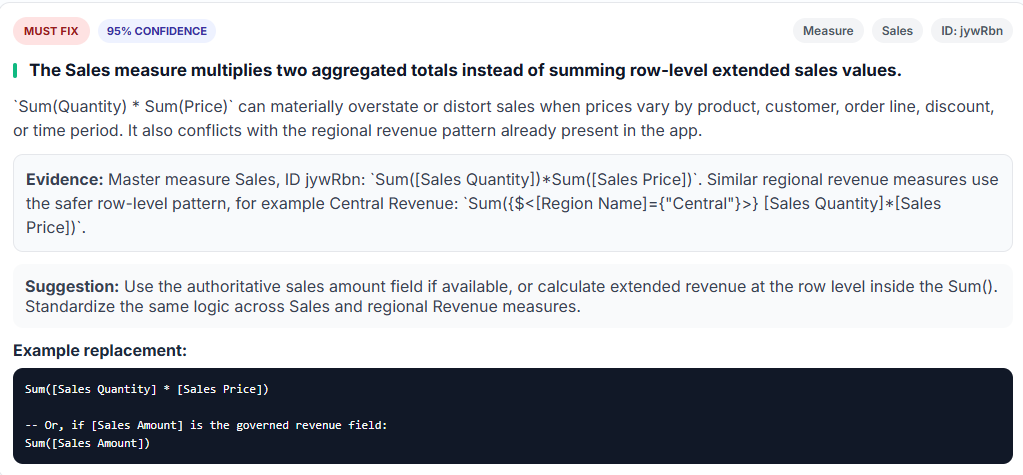
- Could any calculations return unexpected results?
- Are values or dates hard-coded unnecessarily?
- Is logic duplicated across several objects?
- Are master items being used effectively?
- Are there performance or security concerns?
- Will the application still be maintainable in six months?
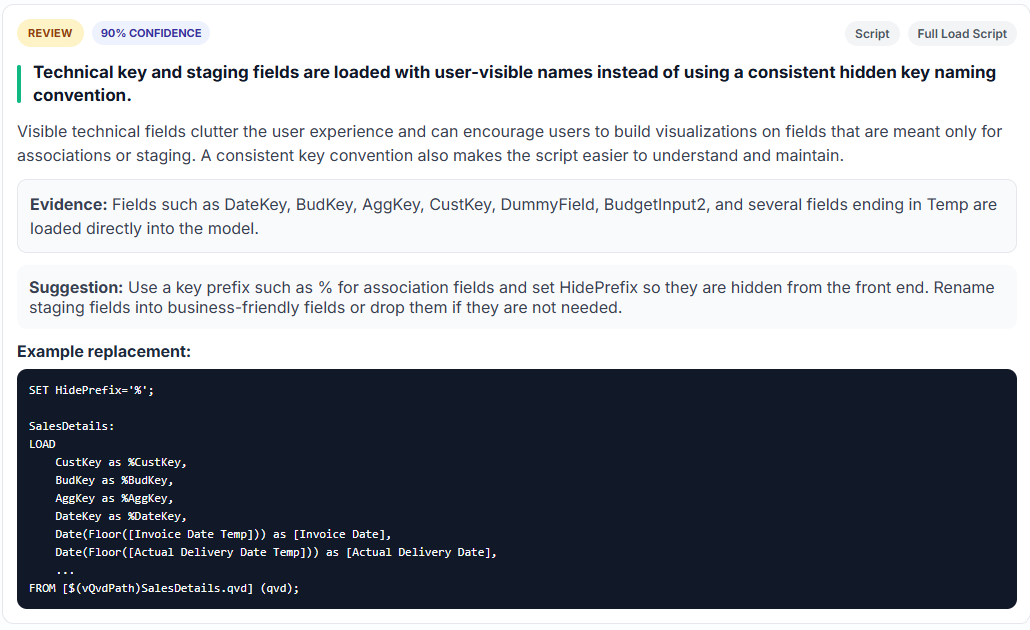
Not every finding is a defect. Some findings simply identify an area that deserves another look, and sometimes the existing implementation will still be the correct choice.
The most useful review explains why a finding matters and suggests a practical next step. A long list of unexplained warnings creates work without creating understanding.
Why Traditional Peer Reviews Do Not Scale
As Qlik applications grow, manual review becomes increasingly difficult. A mature application may contain thousands of lines of script, hundreds of measures, many variables and a large number of object-level expressions.
Reviewing every element manually is rarely realistic. Most traditional reviews become sampling exercises, with developers checking the most visible areas and hoping that nothing important has been missed elsewhere.
Another problem is visibility. Review findings are often shared only between developers through a meeting, chat message or informal notes. Business owners and other non-technical stakeholders may know that a review happened without understanding what was found, what was improved or what risks remain.
A scalable review process needs to be consistent, repeatable and capable of turning technical findings into clear information that can be shared more widely.
Qlik Sense Peer Review Best Practices
- Review a stable, committed version rather than a moving working copy.
- Use a consistent checklist across applications and developers.
- Review scripts, expressions, variables and master items together.
- Prioritize findings by risk and impact.
- Explain why each significant finding matters.
- Recognize positive development practices as well as problems.
- Record review outcomes against the release.
- Share an accessible summary with non-technical stakeholders.
- Use review findings to improve team standards over time.
Why DevFulfilled Is Different
DevFulfilled has been designed specifically to review Qlik Sense applications. It does not simply send all application metadata to one general-purpose prompt and return a block of AI-generated advice.
Instead, DevFulfilled uses a specialized review pipeline that examines different aspects of the application independently before combining the results into a final assessment.
Dedicated review stages investigate areas such as load scripts, master measures, variables, dimensions and object-level expressions. Each stage can concentrate on the development patterns, risks and best practices most relevant to that part of the application.
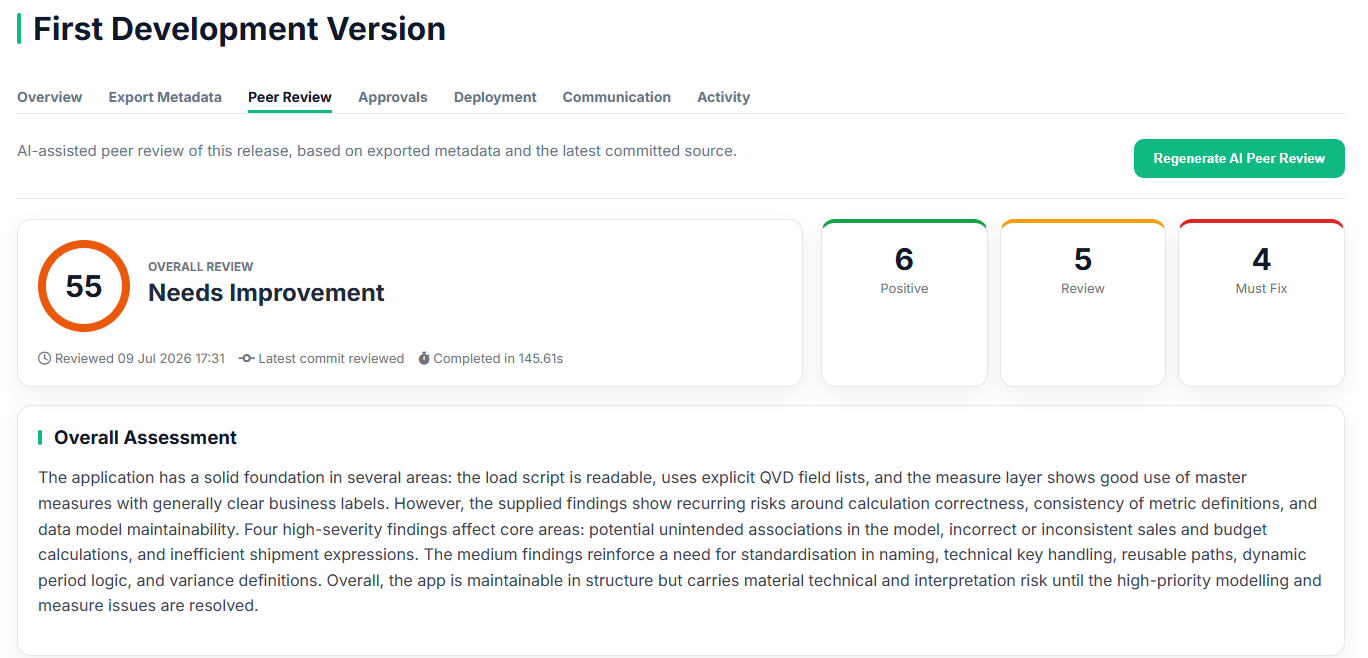
Those specialist findings are then brought together to produce an overall quality summary, prioritized recommendations and practical next steps. The result is designed to be useful to experienced developers while also providing a clear summary that can be shared with technical leads, project owners and non-technical stakeholders.
Behind every review sits a growing library of specialist prompts, structured outputs and validation rules. These are continually reviewed and refined using real-world experience, evolving Qlik development practices and feedback from developers using the platform.
New review capabilities can be introduced over time, allowing the assessment process to become broader, more consistent and more useful without requiring development teams to build and maintain their own AI review framework.
DevFulfilled provides:
- A comprehensive application quality assessment.
- Specialist analysis across multiple areas of the application build.
- Prioritized findings based on risk and likely impact.
- Practical recommendations rather than generic observations.
- Positive feedback that recognizes good development practices.
- Consistent reviews across every release.
- Clear summaries for technical and non-technical audiences.
Effective AI peer review is not created by writing one clever prompt. It requires multiple specialized review stages, carefully designed instructions, structured outputs, validation and continual refinement to produce reliable, repeatable results.
The objective is not to replace experienced developers. It is to help them focus their time where their judgement provides the greatest value.
Conclusion
Peer review remains one of the most valuable quality assurance activities in software development. It reduces defects, improves consistency and helps knowledge move between developers rather than remaining with one individual.
The challenge has never been recognizing its value. The challenge is finding enough time to perform reviews thoroughly and consistently.
AI-assisted review makes broader analysis achievable by examining large volumes of application metadata and highlighting the areas most likely to benefit from human attention.
The result is not fewer human reviews. It is better human reviews.
Video Demo
See how DevFulfilled uses AI to review your Qlik Sense metadata before deployment, helping you spot potential issues, recognize good practices, and deliver with greater confidence.
Frequently Asked Questions
Does AI replace a human peer review?
No. AI should support developers rather than replace them. Business context, architectural decisions and intentional design choices still require experienced human judgement.
Can AI understand Qlik expressions?
Modern language models can analyze Qlik load scripts, set analysis, variables, master items and object-level expressions for many common risks and development patterns. Their recommendations should still be assessed by someone who understands the application and its data.
Will AI produce false positives?
Occasionally. That is why findings should be treated as informed recommendations rather than automatic defects.
Is every finding a problem?
No. Some findings highlight an area that deserves attention, while the existing implementation may still be appropriate for the application's particular requirements.
Should every release have a peer review?
Ideally, yes. The depth of review can reflect the size and risk of the change, but even a lightweight review is usually better than no review.